Five deliveries, each with the result, the setup it was measured under and, where the work is public, the code to rerun it. Client names are shared on request, with each client's consent.
Hydrography · research contract · 2026
The seabed under a 2,327 km trade route, completed where 17% had ever been sounded.
Built for the Churchill corridor question: what lies under a keel where no survey ship has been. SeabedNet is a masked-completion network trained on the Canadian Hydrographic Service archive with a gravity anchor. It produces a depth, a calibrated uncertainty and a provenance flag for every 100 m cell, and a separate model for the shallowest point a keel could meet.
Trained only on soundings published before 2016, it predicts the 6.46 million published since to a mean error of 12.45 m, against 18.08 m for the gravity prior that charts fall back on and 18.85 m for the nearest published sounding. On 386,685 independent research-cruise multibeam cells it scores 9.6 m. Five of seven documented groundings fall in the top 10% of its hazard field when hindcast from the soundings that existed before each strike. A 1,314-cell forecast is sealed with SHA-256 and OpenTimestamps for the next survey to grade. It is a planning prior, not a navigation product.
Queen Maud Gulf, our render. Surveyed soundings in blue, model completion in amber.
Test
Cells
SeabedNet
Gravity prior
Post-2016 soundings, mean error
6.46 M
12.45 m
18.08 m
Research multibeam, 17 blocks
386,685
9.6 m
6.1 m
Ship soundings, shelf, median
278,898
4.9 m
—
Blackwell serving · DGX Spark owners · October 2026
The fastest public number for a 27B model on a DGX Spark, and the before-and-after an owner receives.
Most Blackwell machines run the default tooling and deliver a fraction of what they cost. Our serving program keeps a standing benchmark on our own Spark. An all-NVFP4 build of Qwen3.8-27B with a DFlash2 drafter reaches 62.5 tokens per second on the public ranking cell, two users at 16k context, forty runs, against a posted record of 60.57. Quality held: 89 of 100 on GSM8K against 87 for the plain checkpoint, no change on MATH-500 levels 4 and 5.
For an owner, the deliverable is the table on the right: the box as it arrived, running Ollama, and the same box under our serving profile, measured the same afternoon. The profile, the scripts and the rerun command are handed over. How the record run was measured.
Configuration
Workload
tok/s
Ollama, default build
chat, single user
27.9
Ollama, MTP q8 build
chat, single user
19.9
Pylox serving profile
code, single user
67.7
Pylox serving profile
file edits, single user
126.2
Pylox multi-user profile
two users at 16k context, total
54.3
Pylox record build
public ranking cell, 40-run mean
62.5
One DGX Spark, Qwen3.8-27B, 20 and 21 October 2026. llama-benchy and our speed harness, 256-token generations.
Robotics · energy measurement · August 2026
What a robot policy costs per task it completes.
For teams putting learned policies on small Jetson modules, the question is energy per successful task, not watts. We measured a vision-language-action policy at the power rail of a Jetson Orin Nano across 100 LIBERO-Spatial episodes and 15,650 policy steps, then four policies from 0.2M to 450M parameters on the same rail. Energy is charged to successes, so a configuration that saves power by failing more pays for its failures.
The finding that matters to a buyer: a 19 million parameter diffusion policy costs five times a 30 million parameter transformer policy per step. Parameter count does not set the bill; the inference structure does. The same vision-reuse optimization returns 18.9x on one policy and 1.55x on another. Six TensorRT engines run on one Orin Nano, each precision chosen after an overflow analysis. Harness and raw device logs.
LIBERO-Spatial evaluation episodes from our runs, slowed 3.3x.
Datacenter serving · throughput records · May 2026
One B200, Llama-3.1-8B: 43,509 to 69,461 tokens per second, verified in two datacenters.
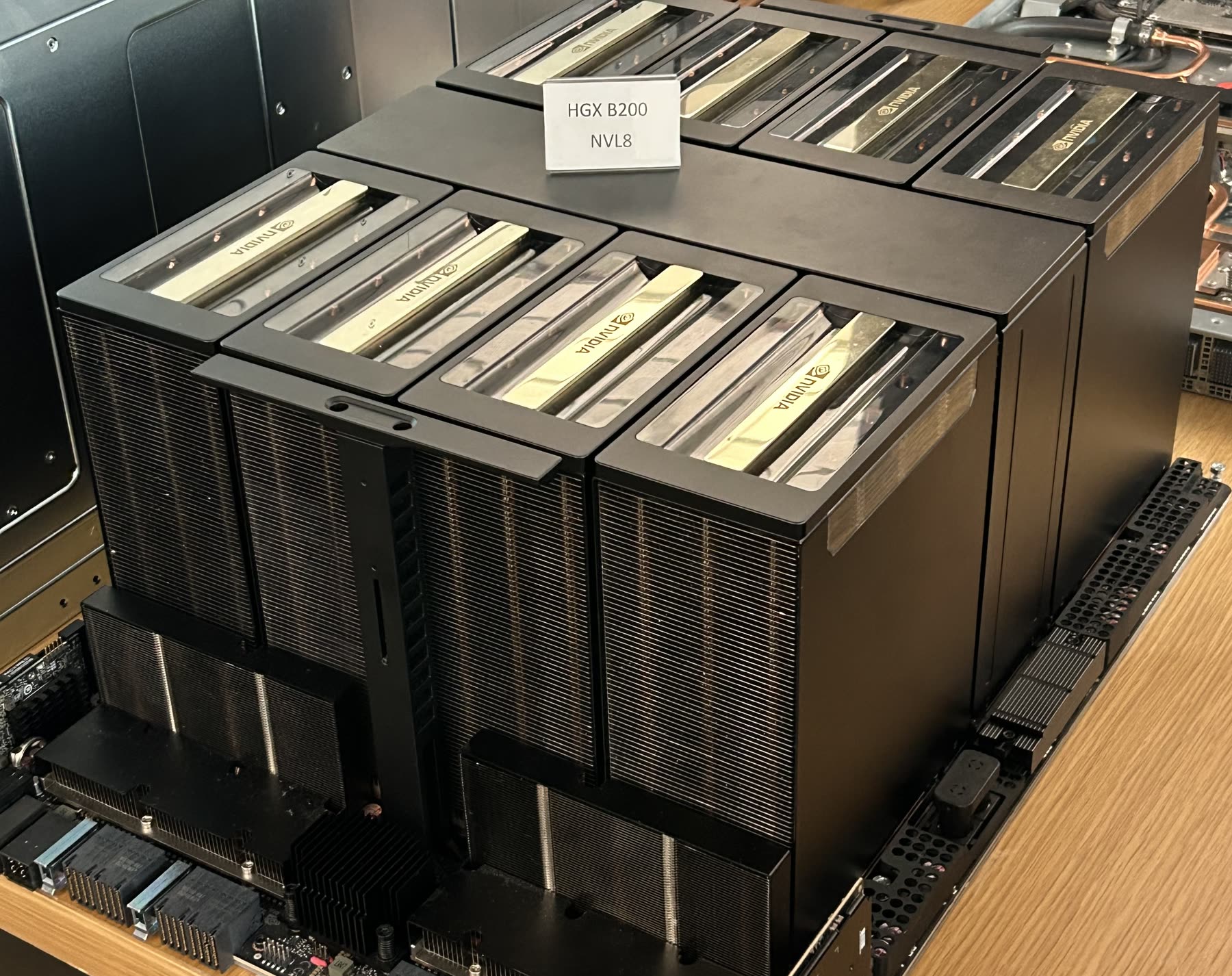
For clients sizing a Blackwell deployment: how much offline throughput one datacenter card gives at NVFP4, and whether the number survives a second machine. It did. At 128 tokens in and out with about 2,300 concurrent requests, the first machine served 43,509 tokens per second at 696 W and the second 69,461 at 917 W.
Single-user figures from the same campaign are not quoted. Our own audit found they depended on prompt memorization in a memory-based drafter, and we publish the audit alongside the results. From the same program: 7,309 speculative-decoding blocks with four drafters verified on identical prefixes showed that switching drafters per workload is worth 0.6%, and switching per block captures 61% of a 13.3% oracle gap at 43% of the cost. Code and data.
HGX B200 board. Photo: Pokiiri, CC BY-SA 4.0, cropped.
Language and voice · Québec market · May to August 2026
An open Québec French model, and the voice product that answers a Montréal phone number.
Hochelaga-8B is a full-parameter continued pretrain of Qwen3-8B-Base on a corpus we assembled, then task fine-tuning, trained and served on our own Grace Blackwell system. It scores 85.44% on QFrCoLA's 7,546-sentence test split against 83.85% for Claude Opus 4.7, both measured by us with the same prompt. It was trained on the task's training split, which the model card says in its first paragraph. Open weights in BF16 and NVFP4 with an EAGLE-3 drafter, Apache-2.0.
Maxim, the voice product built on it, has served the public web since July 2026 and a Montréal phone line, with a 7B full-duplex speech model trained on 147 hours of speech across two H100s. Serving Hochelaga-8B at NVFP4 on one RTX 5090: 212 tokens per second single stream, 8,908 aggregate at 800 clients. Model card.
QFrCoLA test split, 7,546 sentences
Accuracy
Macro-F1
Majority class
69.65
41.04
Hochelaga, pretraining only
69.65
41.56
Claude Opus 4.7, zero-shot
83.85
78.29
Hochelaga-8B, fine-tuned
85.44
82.36
Managed platform · Montréal · October 2026
A Grace Blackwell development platform, built and operated for a client's engineering team.
A GB10 system turned into a shared working environment for a development team: per-user accounts, a GPU lease so one heavy job runs at a time and every kill names whose job it was, an off-box log and heartbeat, a memory wall that kills the newest runaway job before the unified pool is exhausted, a hardware watchdog, and an encrypted nightly backup line with weekly restore tests. Every system change ships as a package with plan, apply, rollback and verify.
The platform mirrors the lab environment that runs our own machines, packaged so a team of new users can work on it from day one. Live since October 2026. This is what the Operate engagement looks like.
Operations standard
What it does
GPU lease
One heavy job at a time, named owner, broker-assigned
Memory wall
Kills the newest growing job before the pool is exhausted
Watchdog
Hardware reset on a true hang, with a reboot-loop brake